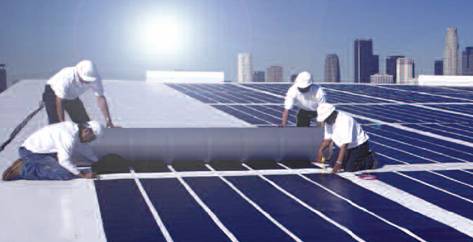
We encourage everyone to go into solar, but you have to look at some general considerations before you’ll buy and use your solar system...
The best opportunity to go solar is when you move to a new home. This will give you the chance to design and orient the way you are going to use solar power at your place. A green oriented home build in a way it can admits the sun power at the winter for decreasing heating costs and rejecting overhead sun rays in the summer to reduce the cooling bills. Your architect should consider these principles when remodeling the house. A mere 5 degrees alternation in the home orientation can save thousands of dollars.
Connecting to solar grid
It is common in the US to buy electricity from renewable energy resources, including solar power, wind farms, plants oil, geothermal energy and more. The electricity grid usually allow you to get your energy from such sources, and moving to such green energy suppliers is a good way to go green. This is a way to use clean energy without buying the equipment. However, using your own equipment, however expensive, can save you money in the future, and give you independence
Your own power.
If a after building your home energy efficient you still have high bills, and your area is sunny enough, you might consider producing your own electricity with PV panels. The technology is being developed all the time, and new solar panel are available that can integrate with your roof, without much visibility.
Generating your electrical energy from the sun with a PV panels is much easier than it appears. Don’t let somebody tell you it’s complicated – it really isn’t. Just little knowledge will get you started on ordering the right components. For installation, you can hire an experienced solar installer, or if you have some basic electrical skills you can even do it yourself.
Just don’t forget that there are some building rules and regulations you have to follow.
What you ought to know before going solar in a new house?

The Future of Solar Homes
Thirty years ago in a number of countries around the world, a push began to install solar energy panels on private houses. Many experts argues that solar power, including solar energy incorporated into residential property, was to be the proverbial wave of the future. In reality, the early movement towards solar energy slowed down during the latter part of the decade and into the 1980s. A major concern associated with solar homes centered on the fact that many consumers discovered that the installation and utilization of solar power systems into their homes was not proving particularly cost effective.
First, an increasing segment of the media has become concerned with the impact that carbon based energy sources are having on the environment, on the planet. As a consequence, there are an ever growing number of people who are making a concerted effort to make their living spaces far more environmentally friendly. From recycling to the use of alternative energy resources such as solar power, more men and women all of the time are becoming committed to establishing and maintaining homes that are more environmentally friendly.
Second, the costs associated with petroleum, coal and natural gas as primary sources of power have increased dramatically over the course of the past several years. The net result of this tremendous cost increases has been to make alternative energy resources - including solar power - far, far more cost effective. Therefore, many people are now turning (or returning, as the case may be) to solar homes because these types of residences have become cost effective in the current marketplace.
While some people are hoping (and likely against hope) that the costs associated with petroleum, coal and natural gas will drop sooner rather than later, most industry experts and financial analysis predict that this likely will not be the case. Therefore, research and development is becoming more intense when it does come to alternative energy resources such as solar homes. Moreover, consumer demand for alternative energy resources, including residential property that relies on solar power, is increasing markedly. These are companion long-term trends that are expected to continue into the future.
With this in mind and understood, many financial experts and analysts are suggesting with increasing regularity that making investments in such alternative energy resources such as solar homes is a wise course to take. These analysts maintain that the days are long gone when an investment in solar home technology was considered speculative at best. Rather, investments in such alternative energy resources such as solar homes is considered to be a sound course which will allow for the realization of significant profits in both the short and the long term.
R. Douglas Allen is managing partner of Blue Lion Capital Management, a private equity company specializing in clean technology and alternative energy. You can learn more about Blue Lion Capital Management and Mr. Allen by visiting this site:
http://www.bluelioncapitalmanagement.com
For Media Inquiries email Mr. Allen at: rdouglasallen at bluelioncapitalmanagement.com
Solar Home Improvements without Panels
by: Rick Chapo
You’ve grown tired of paying monstrous electric bills and have decided to go solar. Solar panels, however, aren’t exactly your taste. Don’t worry, you can go solar without them.
Solar panels are used to convert sunlight into electricity, which can be used to light and heat a home. They are not, however, the only method for accomplishing these goals with the sun. A simple experiment you can try in your driveway will show you why.
Park your car in a sunny spot on your driveway. Get in, mark the time, close the vents and roll up the windows. It starts getting pretty warm pretty quick, eh? You’ve just experience a concept known as direct gain energy. The power of the sun is more than sufficient to create heating and lighting if it is manipulated to hit your home in the right way.
Direct gain is a concept that has existed for thousands of years. Before electricity was in abundant supply, ancient societies planned entire structures around the concept. You can learn from their experience.
Once gardening issues are resolved, you need to take a close look at the surface areas. Much like a car, it is important that the sun has a method for penetrating the exterior of the home. The primary issue concerns windows. Are there any and, if so, how big are they?
The easiest method to generate solar heat in your home is by placing large windows on the south side of the home. Home Depot, here we come. To truly maximize the effect, you should also have two additional components.
The first is a fan system that will help circulate air out into the rest of the home. The temperature differences from room to room will eventually equalize, but a few ceiling fans can help.
The second issue to consider is your flooring. Windows are great and all, but what happens when the sun goes down? No more sunlight and no more heat. To overcome this problem, you can make improvements to the flooring below the windows. Yank up the carpet and put in some material that soaks up the sunlight. Certain ceramic and masonry products will hold significant amounts of heat. As the sun beats down on them, they slowly heat up during the day. Once the sun sets, they start giving off heat which allows you to maximize your passive solar system.
While this strategy will not replace your traditional heating costs, it can act as a supplemental system to take care of heating issues during the day and early evening. Break out your hammer and you can cut a chunk out of your utility bill!
About The AuthorRick Chapo is with http://www.solarcompanies.com – a directory of solar energy and solar power companies. Visit http://www.solarcompanies.com/articles to read more solar electricity articles.
Solar Power- Power From the Roof
The hot topic nowadays around the globe is “scarcity of power”. As a country moves towards the peak of development, so also does its demand of power. Reports show that there are many homes using electricity more than that used by a small industry! It is because, in the modern, digital lifestyle, each and every appliance like television, computers etc demands huge amount of electricity. However we live in a modern world and hence the usage of these power hungry appliances are inevitable. Joe Cline is a professional real estate broker, investor, and REALTOR with RE/MAX Capital City Austin, Texas. Find out more about Austin Texas real estate and new homes in lakeway Texas.
The fact is that every positive improvement in the society will have a negative impact on natural resources. But in case of power, there are many alternate sources available in nature. Solar energy is a very good substitute for conventional power generation. The reason being, solar energy is clean, has no pollution effects and doesn't use any fossil fuels. The most interesting aspect being solar energy can be generated in home.
How about having your own power station on your roof? It is quite simple and beneficial by using solar power. To start with, solar water heaters can be used in homes instead of old conventional methods, thereby reducing your utility bills and also conserving natural resources like fossil fuels. The solar panels called the photovoltaic cells which can be conveniently placed on the roofs of homes converts sunlight directly into electricity. This electricity obtained by the conversion of sunlight meets all the home's electricity needs. “Hence it acts as your own power station. “Cool power from hot sun”.
A lot of people have tried the usage of solar power at home and found it beneficial and safe. The hot fact is that more than 10,000 homes in United States completely use solar energy to power up their homes. The ill fact is that enough sunlight falls on the Earth's surface every hour to meet the globe's energy demand for an entire year, but the same is not utilized and is wasted.
Still not convinced about the positive effects of solar power in home? By replacing conventional electric water heaters with solar water heaters, one can cut water bills up to 50 percent. And the important fact is, the price of photovoltaic cells, according to the department of energy has fallen by 200 percent in last 30 years. Don’t worry if your solar power unit generates more power than need for you. There are many utility power grids ready to buy the clean power for a higher price.
The bottom-line is, by installing a solar power generating unit in home, the home owner will never have to pay an electricity bill; instead he can become the supplier of clean electricity to the country and “save the Earth from energy crisis”